





Description
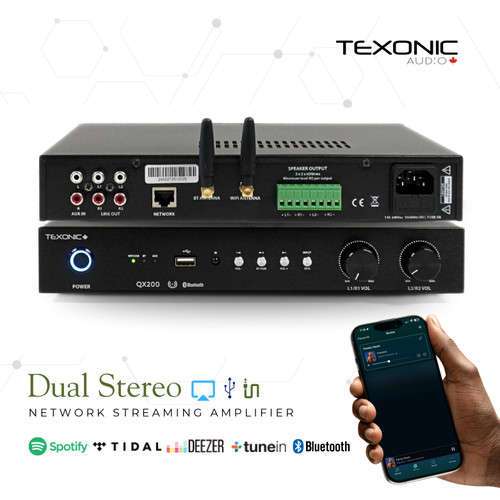
Manage background music in two separate listening areas from one compact Wi-Fi and Bluetooth streaming amplifier.
The TEXONIC QX200 combines four amplifier channels, two independently adjustable volume zones and multiple music sources in one convenient unit. It is designed for compatible 4-ohm or 8-ohm ceiling, wall-mount and indoor speakers used in small business and multi-room audio systems.
Two Stereo Speaker Zones
The QX200 contains four amplifier channels arranged as two stereo zones. Each zone has separate left and right speaker outputs and its own front-panel volume control.
Zone 1: Left and right speaker channels with independent zone volume
Zone 2: Left and right speaker channels with independent zone volume
Total: Four powered speaker channels across two listening areas
Important Dual-Zone Information
Zone 1 and Zone 2 have independent volume control, but both zones play the same selected music source.
The QX200 does not contain two independent streamers. Playing different music in each area requires separate source equipment or a true multi-stream zone amplifier.
Practical Two-Area Sound Control
Independent zone volume allows the same playlist to be heard at a comfortable level in two areas with different sizes, layouts or background-noise levels.
| Application | Zone 1 | Zone 2 |
|---|---|---|
| Café | Customer seating | Counter or service area |
| Retail Store | Main sales floor | Fitting room or back area |
| Office | Reception or waiting room | Staff room or workspace |
| Home | Kitchen or living room | Bedroom, office or covered patio |
Wi-Fi Network Music Streaming
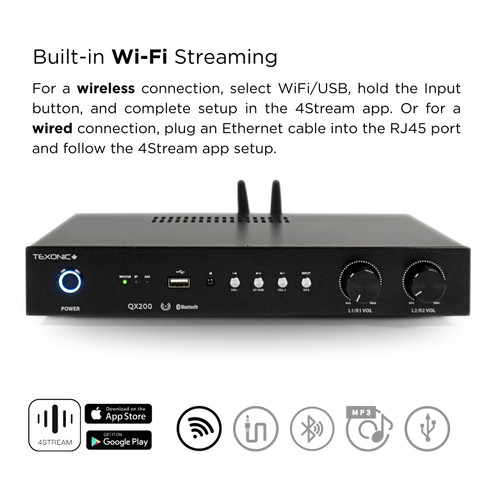
Connect the QX200 to a compatible Wi-Fi network and manage music from the 4Stream app on a supported mobile device.
Network playback is useful for businesses that play music throughout the day because the controlling device does not need to remain within normal Bluetooth range of the amplifier.
Ethernet Connection for Greater Stability
A rear RJ45 network port provides a hard-wired connection to a compatible router or network switch. For permanent commercial installations, Ethernet is recommended where possible for more stable app control and network music playback.
Bluetooth for Quick Wireless Playback
Bluetooth provides a simple way to play music directly from a compatible smartphone, tablet or computer.
Select Bluetooth from the front panel, pair the source device with the QX200 and control normal playback from the connected device, front controls or supplied remote.
USB MP3 Music Player
The front USB port supports MP3 playback from a compatible USB 2.0 flash drive.
The USB connection is intended for music playback only and should not be used as a charging port for smartphones or other devices.
AUX Input for External Audio Sources
The rear AUX input accepts a compatible line-level source such as a computer, television, CD player, tuner or media player.
AUX audio plays through both zones while Zone 1 and Zone 2 retain separate volume adjustment. The AUX input is not designed for direct microphone or speaker connections.
Separate Line Output for Each Zone
Zone 1 and Zone 2 each provide a line-level output for connection to compatible external audio equipment.
A zone line output may feed an additional power amplifier or a powered subwoofer with suitable input, level and crossover controls. Connected expansion equipment is selected separately.
Four Powered Speaker Channels
Each zone includes a left and right amplifier channel. Output power depends on the final speaker impedance connected to each channel.
| Speaker Load | Power per Channel | Total Amplifier Output |
|---|---|---|
| 4Ω | Up to 60W | 4 × 60W / 240W total |
| 8Ω | Up to 30W | 4 × 30W / 120W total |
Speaker Wiring Options
For a standard 8-ohm installation, connect one compatible 8-ohm speaker to each amplifier output.
For wider sound coverage, two compatible 8-ohm speakers may be connected in parallel to one channel, creating a 4-ohm load. The connected speakers share the available channel power.
One 8Ω speaker per channel: Four speakers total, with up to 30W available to each speaker
Two 8Ω speakers in parallel per channel: Eight speakers total, creating a 4Ω channel load with the available 60W shared between the two speakers
Important Speaker Compatibility Notice
The minimum permitted speaker load is 4 ohms per amplifier channel. Do not connect a lower impedance load.
Do not combine the left and right outputs, and do not bridge amplifier channels unless specifically authorized by TEXONIC.
The QX200 is not a direct 70V or 100V commercial amplifier. Do not connect 70V or 100V speaker lines directly to its speaker outputs.
Keep Speaker Polarity Consistent
Connect the positive amplifier terminal to the positive speaker terminal and the negative amplifier terminal to the negative speaker terminal. Consistent polarity helps maintain balanced bass response and even sound coverage throughout each zone.
Front-Panel and Remote Operation
- Independent Zone 1 volume control
- Independent Zone 2 volume control
- Wi-Fi/USB, Bluetooth and AUX source selection
- Bluetooth pairing and disconnect control
- Previous, next and play/pause controls
- WPS network connection and reset function
- Remote bass and treble adjustment
- Standby control from the remote
Compact Installation
The QX200 has a compact chassis that can be placed on a suitable shelf or installed inside a properly ventilated equipment cabinet.
An optional 19-inch rack-mount kit is available separately. The rack kit is not included with the standard amplifier package unless selected when ordering.
Technical Specifications
| Brand | TEXONIC |
| Model | QX200 |
| Amplifier Type | Dual-zone network streaming amplifier |
| Zones | 2 stereo zones with independent volume control |
| Amplifier Channels | 4 |
| Output at 4Ω | 4 × 60W |
| Output at 8Ω | 4 × 30W |
| Minimum Speaker Load | 4Ω per channel |
| Speaker Compatibility | Compatible 4Ω or 8Ω low-impedance speakers |
| Wireless Playback | Wi-Fi network streaming and Bluetooth |
| Network Connection | Wi-Fi or RJ45 Ethernet |
| App Control | 4Stream app on compatible devices |
| USB Playback | MP3 playback from compatible USB 2.0 storage |
| Wired Audio Input | AUX line input |
| Line Outputs | Separate Zone 1 and Zone 2 line outputs |
| Line Input Sensitivity | 500mV |
| Frequency Response | 20Hz–20kHz |
| Signal-to-Noise Ratio | 94dB |
| Dimensions | 28 × 20 × 4.4cm / 11.33 × 7.87 × 1.73 in |
| Weight | 1.8kg / 4 lb |
| Rack Installation | Optional 19-inch rack-mount kit |
What’s Included
- 1 × TEXONIC QX200 streaming amplifier
- 1 × Bluetooth antenna
- 1 × Wi-Fi antenna
- 1 × Remote control
- 1 × AC power cord
- QX200 user manual access
Warranty
TEXONIC QX200 Amplifier: 2-Year Limited Manufacturer’s Warranty
Need Help Matching the Speakers?
Send us the speaker models, impedance, quantity per channel, room dimensions, preferred listening areas and network requirements. We can help confirm the final speaker load and determine whether the QX200 is suitable for the installation.


